
By Kalu Okoronkwo
At 70, Senator Rabiu Musa Kwankwas0, Ph.D, former Governor of Kano State and Vice Presidential candidate of the Nigeria Democratic Congress (NDC) in the January 16,2027 presidential election, represents one of the most intriguing figures in Nigeria’s political space: a politician whose influence is deeply rooted in the political soil of Kano, whose ambitions and alliances have repeatedly drawn him into the wider contest over Nigeria’s future.
His journey from engineering and public service administration to the governorship of his home state of Kano, the National Assembly, the Ministry of Defence and presidential candidate in the 2023 elections, offers more than a personal chronicle of political survival. It tells a story about power, loyalty, grassroots organisation and the challenge of translating regional political capital into a national leadership.
Perhaps one of the most revealing assessments of Kwankwaso’s political journey came from President Bola Ahmed Tinubu in his goodwill message to the former Kano state governor on his 70th birthday. In a statement issued on October 21, 2026, Tinubu acknowledged Kwankwaso’s contributions as a two-term governor, former Minister of Defence, senator and presidential candidate, describing him as an influential figure and a progressive politician.
In a seven paragraph tribute, Tinubu stated: “My warm congratulations to my friend, Dr Rabiu Musa Kwankwaso, former Governor of Kano State, one time Minister of Defence and former Senator representing Kano Central Senatorial District. Senator Kwankwaso and I have longstanding association, dating back to our time in the National Assembly in 1992; he in the House of Representatives and I in the Senate, and later in 1999 when we both emerged as governors of our respective states. “As members of the Class of ‘99 Governors, we both played pivotal roles in laying the foundation for the democracy the nation enjoys today. Shaped by different political choices, our political paths differed until we coalesced in 2013 to form the All Progressives Congress. Since then, history and service have kept us intertwined. “I must acknowledge Senator Kwankwaso’s immense contributions to Kano State and Nigeria as a two-term Governor, former Minister of Defence, former Senator, former presidential candidate, and now a presidential running mate”. “Senator Kwankwaso remains an influential figure and a progressive politician. That we are in different political parties and competing on different platforms in the January 2027 election will not remove my affection for Senator Kwankwaso” the President affirmed.
Tinubu’s acknowledgment that political differences would not erase his affection for Kwankwaso is a reminder that democratic competition need not extinguish personal relationships. It also offered a glimpse into the political history of a man whose career has been shaped by alliances, disagreements, changing party affiliations and a persistent determination to remain relevant in Nigeria’s evolving political order.
As Kwankwaso marked his 70th birthday on October 21, 2026, the occasion invited reflection not only on the offices he has occupied but also on the movement he has built, the constituencies he has mobilised and the political questions his next chapter raises. His emergence as the vice-presidential running mate to His Excellency, Mr. Peter Obi, former Governor of Anambra State on the Nigeria Democratic Congress (NDC) platform has given that chapter a new dimension, bringing together two former governors whose political careers developed in different regions but whose public narratives share an emphasis on human capital, public accountability and the promise of more responsive governance.
Born on October 21, 1956, in Kwankwaso village in Madobi Local Government Area of Kano State, Senator Rabiu Musa Kwankwaso began his professional journey in engineering at the Kaduna Polytechnic and subsequent postgraduate studies in the United Kingdom. He pursued a career in public service with the Kano State Water Resources and Engineering Construction Agency, where he worked from 1975 to 1992.
This background is relevant to understanding the political persona he would later cultivate. Engineering demands an appreciation of systems, resources, planning and the relationship between design and delivery. Public administration demands the additional discipline of balancing competing interests, managing institutions and accounting for decisions. Although professional training alone does not guarantee effective governance, Kwankwaso’s early career placed him in the practical world of public infrastructure before he entered the more volatile arena of partisan competition.
His formal entry into national politics came with his election to the House of Representatives in 1992, representing Madobi Federal constituency. He subsequently became Deputy Speaker of the House, gaining legislative experience during a turbulent period in Nigeria’s political history. The interruption of democratic government in 1993 altered the trajectory of many political careers, but the return to civilian rule in 1999 reopened the arena in which Kwankwaso would establish his most enduring political identity.
That year, he became governor of Kano State, arguably the North’s most politically sagacious state. Kano is more than a geographical territory: it is a commercial hub, a major population centre and a place where politics is shaped by the interaction of traditional institutions, religious and community networks, traders, workers, students and a large youth population. Governing it requires an understanding of the relationship between political authority and everyday social realities.
Kwankwaso’s first tenure, from 1999 to 2003, placed him within the generation of civilian leaders who helped consolidate Nigeria’s Fourth Republic. His subsequent appointment as Minister of Defence broadened his experience beyond state administration, while his return to the Kano Government House in 2011 demonstrated that his political relevance had survived a period outside the governorship. He served his second term until 2015, later represented Kano Central in the Senate from 2015 to 2019, and entered the 2023 presidential election as the candidate of the New Nigeria Peoples Party (NNPP).
This chronicle is very important as it underscores Kwankwaso’s continued relevance in the politics of the Fourth Republic. He has operated as a legislator, governor, a minister and a presidential candidate. His has also changed parties and build alliances in his political trajectory. Such shifts are part of Nigeria’s competitive political environment, where personal networks, party structures, regional interests and calculations about the future often intersect. They are best understood not as a simple tale of uninterrupted ascent, but as the evolution of a politician repeatedly seeking to preserve and expand his political base.
For a leader who has spent decades in public life, birthday tributes inevitably invite a more demanding question: what remains after the offices have been vacated? In Kwankwaso’s case, education, infrastructure and human-capital development occupy a prominent place in the account of his governorships. His published biography highlights investments in schools, universities, vocational and manpower development institutions, scholarships, roads and housing. Worthy of note is the establishment of two universities and 26 manpower institutes, alongside more than 2,600 foreign scholarships and extensive vocational training for young people and women.
In a country where poverty, unemployment, uneven educational opportunities and insecurity constrain millions of households, a road can connect markets and communities. A school can widen access to learning. A university can expand a society’s capacity to produce knowledge and professional expertise. Vocational training can open pathways into employment and enterprise. This is where the assessment of Kwankwaso’s legacy must move beyond celebration of birthday. The same standard should apply to every Nigerian leader, regardless of party, region or political following. Public service is not an inheritance to be claimed by loyalists; it is a record to be examined by citizens.
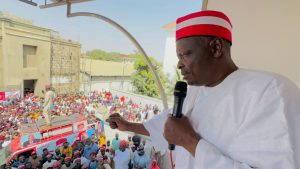
Perhaps the most distinctive feature of Kwankwaso’s political career is the Kwankwasiyya phenomenon. The movement has given his politics an identity that extends beyond the conventional machinery of a party. Its symbolic red cap, recognisable public presence and organised networks have helped make Kwankwaso a readily identifiable figure in Kano politics and among sections of the northern electorate.
The red cap is therefore more than a visual emblem. For adherents, it serves as a marker of political identity and collective belonging. It connects individual supporters to a larger story about representation, opportunity and participation in public affairs. That connection can be a powerful source of mobilisation in a political culture where many citizens feel distant from the institutions that make decisions on their behalf.
Conversely, the political partnership between Mr. Peter Obi and Senator Rabiu Musa Kwankwaso brings together two figures whose careers have developed along different regional and professional trajectories, yet whose public narratives contain points of convergence. Obi emerged from the world of commerce and business before becoming governor of Anambra State. Kwankwaso’s professional beginnings were in engineering and public administration before his own ascent through the legislature and executive government. One built his political identity around fiscal prudence, public accountability and the efficient use of public resources; the other established a political profile closely associated with mass mobilisation, educational expansion and grassroots organisation.
The first area of convergence is the importance both men have attached to human capital. Kwankwaso’s public-service narrative emphasises schools, universities, scholarships and vocational training. Obi’s record and public commentary have placed considerable emphasis on education, healthcare, fiscal responsibility and the redirection of public resources towards social development. Their approaches and records require separate evaluation, but both have made the relationship between public spending and citizens’ long-term welfare a prominent part of their political identities.
The second is the role of personal political movements in mobilising citizens beyond conventional party structures. Kwankwasiyya has developed a distinctive identity around Kwankwaso, while the Obidient movement became a prominent feature of Obi’s 2023 presidential campaign, particularly among younger voters and sections of the electorate seeking alternatives to established political order. The movements differ in their histories, organisation and social composition, but both illustrate how political identification can extend beyond formal party membership.
A third point of convergence lies in the language of political change. Both men have presented themselves as alternatives to aspects of the established political order.
The partnership also brings distinct political assets and challenges into the same conversation. Kwankwaso’s established network in Kano and his broader northern connections offer a different constituency base from the one associated with Obi’s strongest mobilisation in 2023. Their alliance could create opportunities for dialogue across regional lines.
On May 3, 2026, Obi and Kwankwaso formally joined the Nigeria Democratic Congress (NDC). Later that month, the NDC ratified Obi as its presidential candidate for the 2027 election, and Obi announced Kwankwaso as his running mate. The development brought their respective political constituencies into a shared electoral project and placed the former Kano governor in a new role within his long pursuit of national leadership.
Kwankwaso’s 70th birthday offers a moment to consider the relationship between political influence and national responsibility. His career has given him a distinctive place in Kano politics, while the Kwankwasiyya movement has made him a recognisable figure in wider debates about grassroots mobilisation and northern political representation.
His partnership with Peter Obi under the NDC banner adds a new chapter to that story. It brings together two politicians with different backgrounds, distinct political movements and overlapping public commitments to development and improved governance. The significance of Kwankwaso at 70 is not that the journey is complete. It is that the journey has reached another point at which experience must be tested against responsibility, influence against institutional purpose, and political loyalty against the demands of public accountability.
Kwankwaso’s place in Nigeria’s political history is already a subject of serious discussion. His unfinished quest for national leadership will be judged not merely by the offices he seeks, the alliances he enters or the size of the crowds he commands, but by the substance of the ideas he advances, the quality of the institutions he helps to strengthen and the public value that his years of political engagement ultimately leave behind. For Kwankwaso, therefore, 70 is neither merely an age nor an occasion for nostalgia. It is a moment to examine a legacy still in motion.
In the final analysis, the most enduring legacy of any political leader is not the length of time spent in public life, the number of offices occupied or the intensity of personal loyalty. It is the extent to which that life contributes to a society in which citizens have greater access to opportunities, public institutions command greater trust and the promise of leadership becomes visible in the everyday experience of the people. That is the unfinished work of public service. And that is why, at 70, Kwankwaso’s political story remains a legacy still in motion.
Kalu Okoronkwo is a communications strategist, a leadership and good governance advocate dedicated to impactful societal development and can be reached via kalu.okoronkwo@gmail.com.