


By Kalu Okoronkwo
On the morning after Christmas in 2025, a rare emotion swept across Nigeria’s battered security landscape: relief. For a nation exhausted by years of bombings, kidnappings, and insurgent raids, the news that the administration of President Donald Trump had authorized strikes on terrorists’ hideouts inside Nigeria landed as an unexpected moment of hope. The Christmas day operation, reportedly targeting camps linked to Boko Haram and Islamic State West Africa Province (ISWAP), was widely interpreted as the beginning of a more decisive international effort to dismantle terrorists’ networks around the country. Across homes, military barracks, and policy circles, many Nigerians believed the tide might finally be turning.
Yet, once again, Nigerians found themselves staring into a frightening resurgence of terror. In the past few weeks alone, Nigeria has mourned fallen soldiers, grieving families, and shattered communities as armed groups intensify attacks across the country. From the North East to the North-Central region and North West, the rhythm of violence is vibrating with alarming confidence. The troubling question in the minds of many Nigerians is simple, yet unsettling: where is the much-touted security partnership with the United States?
The recent killings of senior Nigerian military officers have shaken the armed forces. Among those reportedly slain in renewed terrorists’ attacks are Lt. Col. Umar Faruq, Lt. Col. S. I. Iliyasu, and Major U. I. Mairiga, alongside numerous soldiers who died defending the territorial integrity of Nigeria.
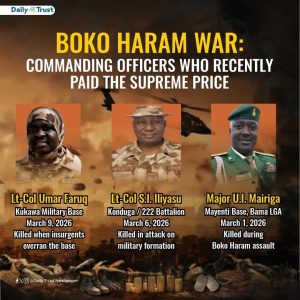
These attacks, largely attributed to factions linked to Boko Haram and ISWAP, demonstrate that the insurgency remains adaptive, strategic, and deeply entrenched despite years of military operations.
In Plateau State, another tragic episode unfolded in Wase Local Government Area, where gunmen ambushed a Nigerian military convoy on regular patrol in the evening of Friday, March 13. Reports indicate that about 14 soldiers, including senior officers, were killed in the brutal assault. The attackers struck with deadly precision, underscoring the growing boldness of armed groups operating across Nigeria’s Middle Belt.
The Plateau ambush is particularly troubling because it signals the widening geographic spread of insecurity. For years, Nigeria’s war against terror was largely concentrated in the North East. Today, the threat landscape has expanded to include bandit in several states across Nigeria.
Kidnapping for ransom has become an industry of fear. Villages are raided, highways have become perilous, and entire communities now live under the shadow of armed gangs operating with increasing impunity.
Recent reports also indicate that the terrorists have intensified coordinated attacks on military installations in Nigeria’s North East and North West, overrunning bases, killing officers, and seizing weapons and military equipment. These raids are not random acts of violence; they are calculated operations designed to weaken the morale and operational capacity of the Nigerian military.
For years, Nigeria’s war against insurgency has been largely domestic, fought with immense sacrifice by soldiers battling insurgents across unforgiving terrain, often with limited resources. The Christmas Day strikes, however, appeared to signal something different: the visible entry of American fearsome military into the conflict.
The symbolism was significant. The United States had long been Nigeria’s security partner, but its involvement had mostly remained behind the scenes: through intelligence sharing, trainings, and occasional logistics support. Direct strikes against insurgent positions suggested a new level of urgency and commitment. To many Nigerians, the message seemed unmistakable: the world’s most powerful military had joined the fight.
The operation appeared to herald a new phase in bilateral security relations, one in which Washington would provide intelligence, surveillance, and strategic support to help Abuja degrade terrorists’ networks operating across the country.
Following the strikes, a Nigerian delegation led by National Security Adviser, Nuhu Ribadu, traveled to Washington to discuss expanded security cooperation and counterterrorism efforts with U.S. officials. At the time, the Nigerian government praised the strikes and confirmed intelligence collaboration.
The message seemed clear: Nigeria would no longer confront terrorism alone. But barely months later, the reality on the ground appears to tell a different story. Insurgents are overrunning military positions. Senior officers are being killed in combat. Communities continue to suffer kidnappings and attacks.
If the December strikes represented the beginning of a deeper partnership, many Nigerians are now asking a simple question: what happened afterward?
The resurgence of attacks raises uncomfortable questions about the effectiveness or even the continuity of the Nigeria–U.S counterterrorism partnership. Did the strikes deliver only symbolic impact without sustained follow-up operations? Was intelligence cooperation strengthened in meaningful ways? Did Nigeria receive the operational support required to dismantle terrorists’ supply networks and safe havens?
These questions have become more urgent as these insurgents appear capable of regrouping, rearming, and launching coordinated attacks against military targets. Analysts have long noted that terrorists’ groups often exploit gaps in sustained military pressure, retreating temporarily only to return once pressure eases.
The diplomatic mission led by Nigeria’s National Security Adviser to Washington was intended to reinforce cooperation and reassure both countries of their shared commitment to combating terrorism.
Looking back, some observers have begun asking a provocative question: was the delegation meant to deepen American involvement or quietly limit it?
The resurgence of attacks has created a troubling perception that the United States may have stepped back from any direct operational role, leaving Nigeria to shoulder the burden of terrorism largely on her own once again.
If that perception is inaccurate, then both governments owe Nigerians greater transparency about the true state of the partnership.
Such suspicions often arise when insecurity persists for years without clear resolution. Within Nigeria’s political discourse, allegations have occasionally surfaced suggesting that elements within the political system may benefit directly or indirectly from the continued insecurity.
Some critics argue that prolonged insecurity sustains enormous security budgets, emergency procurement contracts, and political narratives that justify extraordinary government powers. These claims remain contested and controversial, yet they continue to circulate precisely because the conflict has endured for more than a decade despite massive military spending and international partnerships.
As Amnesty International has warned in previous reports, thousands of Nigerians have been killed by armed groups while authorities struggle to provide effective protection across several states.
The tragedy of Nigeria’s counterterrorism struggle is not merely that attacks continue. It is that after years of military campaigns, international partnerships, and billions of dollars spent on security, terror networks still retain the capacity to strike military bases, ambush convoys, and terrorize communities.
The death of brave officers and soldiers in recent weeks is a painful reminder that Nigeria’s armed forces remain locked in a dangerous and complex war.
What Nigeria needs now is a coherent national strategy and one that combines military strength, intelligence coordination, regional cooperation, and transparent international partnerships.
If the United States remains Nigeria’s strategic ally in the war against terror, Nigerians deserve clarity about the true scope of that partnership. Is it intelligence sharing, training of Nigerian military or operational support? Or is it merely diplomatic reassurance?
Because as insurgents regroup and violence spreads across regions once considered relatively safe, Nigeria stands at a dangerous crossroads.
And in this moment of uncertainty, one question continues to echo across the country:
If terror is rising again, why does the partnership appear silent?
Counterterrorism experts often caution that airstrikes alone rarely end insurgencies. While they may destroy camps and eliminate commanders, militant networks frequently adapt by decentralizing operations, blending into civilian populations, and exploiting ungoverned spaces.
Today, as terror incidents once again puncture the fragile sense of security across parts of the country, Nigerians are left wondering whether the relief they felt on that Christmas day bombing in 2025 marked the beginning of a real turning point or merely a brief pause in a war that still refuses to end.
Until that question is answered with clarity, one haunting reality remains: the promise of that Christmas relief now feels unreal.
Kalu Okoronkwo is a communications strategist, a leadership and good governance advocate dedicated to impactful societal development and can be reached via kalu.okoronkwo@gmail.com


wow i really like this article, very well detailed and a lot of time is invested in this. keep up the good work and i will be checking back for new update. thanx https://moldremediationwilmingtonnc.com/
Pretty! This has been a really wonderful post. Many thanks for providing these details.
wow i really like this article, very well detailed and a lot of time is invested in this. keep up the good work and i will be checking back for new update. thanx https://moldremediationwilmingtonnc.com/
very informative articles or reviews at this time.
You’re so awesome! I don’t believe I have read a single thing like that before. So great to find someone with some original thoughts on this topic. Really.. thank you for starting this up. This website is something that is needed on the internet, someone with a little originality!
Great information shared.. really enjoyed reading this post thank you author for sharing this post .. appreciated
I do not even understand how I ended up here, but I assumed this publish used to be great
Alprazolam
I very delighted to find this internet site on bing, just what I was searching for as well saved to fav
This was beautiful Admin. Thank you for your reflections.
《我的世界》:全球最受欢迎的游戏。 https://mc163.netlify.app
I truly appreciate your technique of writing a blog. I added it to my bookmark site list and will
Situs Togel
This is really interesting, You’re a very skilled blogger. I’ve joined your feed and look forward to seeking more of your magnificent post. Also, I’ve shared your site in my social networks!
wow i really like this article, very well detailed and a lot of time is invested in this. keep up the good work and i will be checking back for new update. thanx https://moldremediationwilmingtonnc.com/
wow i really like this article, very well detailed and a lot of time is invested in this. keep up the good work and i will be checking back for new update. thanx https://moldremediationwilmingtonnc.com/
**gl pro**
GL Pro is a natural dietary supplement formulated to help maintain steady, healthy blood sugar levels while easing persistent sugar cravings.
**mounjaboost**
MounjaBoost is a next-generation, plant-based supplement created to support metabolic activity, encourage natural fat utilization
wow i really like this article, very well detailed and a lot of time is invested in this. keep up the good work and i will be checking back for new update. thanx https://moldremediationwilmingtonnc.com/
wow i really like this article, very well detailed and a lot of time is invested in this. keep up the good work and i will be checking back for new update. thanx https://moldremediationwilmingtonnc.com/
This is my first time pay a quick visit at here and i am really happy to read everthing at one place
wow i really like this article, very well detailed and a lot of time is invested in this. keep up the good work and i will be checking back for new update. thanx https://moldremediationwilmingtonnc.com/
Good post! We will be linking to this particularly great post on our site. Keep up the great writing
wow i really like this article, very well detailed and a lot of time is invested in this. keep up the good work and i will be checking back for new update. thanx https://moldremediationwilmingtonnc.com/
I truly appreciate your technique of writing a blog. I added it to my bookmark site list and will
I’m often to blogging and i really appreciate your content. The article has actually peaks my interest. I’m going to bookmark your web site and maintain checking for brand spanking new information.
Hocam detaylı bir anlatım olmuş eline sağlık
For the reason that the admin of this site is working, no uncertainty very quickly it will be renowned, due to its quality contents.
I do not even understand how I ended up here, but I assumed this publish used to be great
wow i really like this article, very well detailed and a lot of time is invested in this. keep up the good work and i will be checking back for new update. thanx https://moldremediationwilmingtonnc.com/
wow i really like this article, very well detailed and a lot of time is invested in this. keep up the good work and i will be checking back for new update. thanx https://moldremediationwilmingtonnc.com/
This is really interesting, You’re a very skilled blogger. I’ve joined your feed and look forward to seeking more of your magnificent post. Also, I’ve shared your site in my social networks!
**kerassentials**
Kerassentials is an entirely natural blend crafted with 4 potent core oils and enriched by 9 complementary oils and vital minerals.
**prostadine**
Prostadine concerns can disrupt everyday rhythm with steady discomfort, fueling frustration and a constant hunt for dependable relief.
**prostafense**
ProstAfense is a premium, doctor-crafted supplement formulated to maintain optimal prostate function, enhance urinary performance, and support overall male wellness.
wow i really like this article, very well detailed and a lot of time is invested in this. keep up the good work and i will be checking back for new update. thanx https://moldremediationwilmingtonnc.com/
I very delighted to find this internet site on bing, just what I was searching for as well saved to fav
You’re so awesome! I don’t believe I have read a single thing like that before. So great to find someone with some original thoughts on this topic. Really.. thank you for starting this up. This website is something that is needed on the internet, someone with a little originality!
This is my first time pay a quick visit at here and i am really happy to read everthing at one place
jalantoto | Akses Resmi Bandar Togel Online
Very well presented. Every quote was awesome and thanks for sharing the content. Keep sharing and keep motivating others.
wow i really like this article, very well detailed and a lot of time is invested in this. keep up the good work and i will be checking back for new update. thanx https://moldremediationwilmingtonnc.com/
Hocam Ellerinize Saglık Güzel Makale Olmuş Detaylı
Daha önce araştırıp pek Türkçe kaynak bulamadığım sorundu Elinize sağlık eminim arayan çok kişi vardır.
Makaleniz açıklayıcı yararlı anlaşılır olmuş ellerinize sağlık
I really like reading through a post that can make men and women think. Also, thank you for allowing me to comment!
Hi there to all, for the reason that I am genuinely keen of reading this website’s post to be updated on a regular basis. It carries pleasant stuff.
I very delighted to find this internet site on bing, just what I was searching for as well saved to fav
wow i really like this article, very well detailed and a lot of time is invested in this. keep up the good work and i will be checking back for new update. thanx https://moldremediationwilmingtonnc.com/
Looking for a fun arcade fighter? karate girl vs school bully packs a punch with its simple controls and satisfying combat. It’s a great way to blow off some steam, featuring various opponents and a cool boss fight. Perfect for quick gaming sessions!
Nicely written article. Royal Halls stands out with its grand interiors.
Excellent information about oxygen gas plants.
These outfits look perfect for engagement events.
Awesome! Its genuinely remarkable post, I have got much clear idea regarding from this post
wow i really like this article, very well detailed and a lot of time is invested in this. keep up the good work and i will be checking back for new update. thanx https://moldremediationwilmingtonnc.com/
I do not even understand how I ended up here, but I assumed this publish used to be great
Very insightful post.
Gerçekten detaylı ve güzel anlatım olmuş, Elinize sağlık hocam.
Nice post. I learn something totally new and challenging on websites
I’m often to blogging and i really appreciate your content. The article has actually peaks my interest. I’m going to bookmark your web site and maintain checking for brand spanking new information.
Hocam Ellerinize Saglık Güzel Makale Olmuş Detaylı
This article was very helpful — I learned some great tips today.
What Happens When Adult Attraction Takes Over https://vlxx.pythonanywhere.com
There is definately a lot to find out about this subject. I like all the points you made
This is really interesting, You’re a very skilled blogger. I’ve joined your feed and look forward to seeking more of your magnificent post. Also, I’ve shared your site in my social networks!
wow i really like this article, very well detailed and a lot of time is invested in this. keep up the good work and i will be checking back for new update. thanx https://moldremediationwilmingtonnc.com/
For the reason that the admin of this site is working, no uncertainty very quickly it will be renowned, due to its quality contents.
Good post! We will be linking to this particularly great post on our site. Keep up the great writing
There is definately a lot to find out about this subject. I like all the points you made
This is really interesting, You’re a very skilled blogger. I’ve joined your feed and look forward to seeking more of your magnificent post. Also, I’ve shared your site in my social networks!
Yazdığınız yazıdaki bilgiler altın değerinde çok teşekkürler bi kenara not aldım.
X88 là nền tảng giải trí trực tuyến được nhiều người dùng quan tâm nhờ sự đa dạng trong hệ thống trò chơi và giao diện dễ sử dụng. Khi truy cập x88, người chơi có thể khám phá nhiều chuyên mục hấp dẫn như thể thao, game bài, slot và các trò chơi trực tuyến khác. Trang web được thiết kế tối ưu giúp thao tác nhanh chóng, phù hợp với cả người mới lẫn người đã có kinh nghiệm. Ngoài ra, x88 còn chú trọng nâng cấp hệ thống nhằm mang đến trải nghiệm mượt mà và ổn định trên nhiều thiết bị khác nhau. Nhờ khả năng truy cập linh hoạt và nội dung phong phú, nền tảng này đang dần thu hút sự chú ý của cộng đồng người chơi trực tuyến. Bên cạnh đó, việc cập nhật thường xuyên các hoạt động mới cũng giúp x88 tạo được sức hút riêng, trở thành lựa chọn giải trí quen thuộc của nhiều người dùng hiện nay. VISIT: x88
Alprazolam 2mg
I loved as much as you will receive carried out right here. The sketch is attractive, your authored subject matter stylish. nonetheless, you command get got an edginess over that you wish be delivering the following. unwell unquestionably come further formerly again as exactly the same nearly very often inside case you shield this hike.