

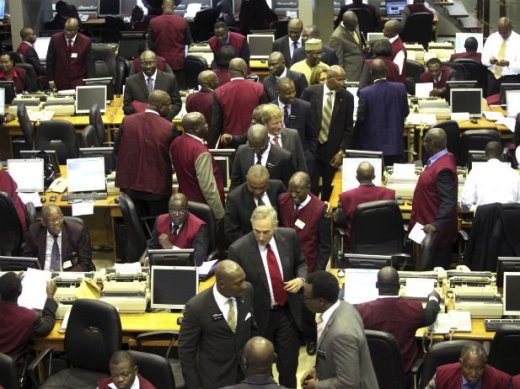
Top-tier listed companies on the Nigerian Exchange (NGX) expanded their cumulative free cash flows by 38.2% year-on-year to reach ₦3.55 trillion during the first six months of 2026, up from ₦2.57 trillion in H1 2025.
The significant cash accumulation underscores a defensive strategy by major corporate leaders aimed at navigating ongoing macroeconomic headwinds, FX volatility, and high operational costs.
Unlike the price –to-book (P/B) ratio and price-to-earnings (P/E) ratio which are non-cash accounting estimates, it is difficult to manipulate cash. That’s why most investors prefer to track cash balance sheets and use as a gauge for the cheapness of a stock or a benchmark for dividend sustainability and corporate stability.
The free cash flow of NGXASI firms stood at N3.55 trillion in the first six months of 2026, which is 38.15 percent higher than 2025’s N2.57 trillion, according to data gathered by MoneyCentral.
Top firms sitting on cash pile include Dangote Cement, whose free cash flow spiked by 30.25 percent to N925.50 billion in June 2026 from N710.56 billion as at June 2025.
MTN Nigeria‘s free cash flow rose by 73.90 percent to N712.70 billion as at June 2026, reflecting strong earnings, disciplined capital allocation and improved operating cash generation, further enhancing the telecommunication firm’s ability to sustain shareholder returns.
Seplat Energy Plc who enjoyed higher crude oil price during the Middle East war sits on a cash pile of N723.75 billion as at June 2026 as the company continues to acquire more rigs with a focus on increasing its market share.
Airtel Africa’s free cash flow reduced by 11.19 percent to N535.95 billion in the period under review from N603.45 billion as at June 2025.
BUA Cement saw its free cash flow stood at N217.77 billion, which is 41.42 percent lower than 2025’s N371.76 billion as at June 2025.
Dangote Sugar becomes the richest cash firm among the consumer goods companies as the largest producer of the sweetener in Africa’s most populous nation saw its free cash flow surge by 1,164 percent to N137.28 billion as at June 2026.
Regardless of sectors, companies need robust cash to be able to pay dividends and settle financial obligations and surmount the macroeconomic storm. Nigeria is a difficult country where incessant currency devaluation caused by the sharp drop in oil price creates a tough and unpredictable macroeconomic environment.
Shares of bellwether firms quoted on the NGXASI have been rallying since the start of the year, which means investors are sanguine about dividend payment and the future growth prospects of companies.
The NGXASI index has a year-to-date (YTD) return of 57.58 percent as the total market capitalisation of listed companies has risen to over N150 trillion from N30 trillion in May 2023.