
By Dr. Nnaoke Ufere
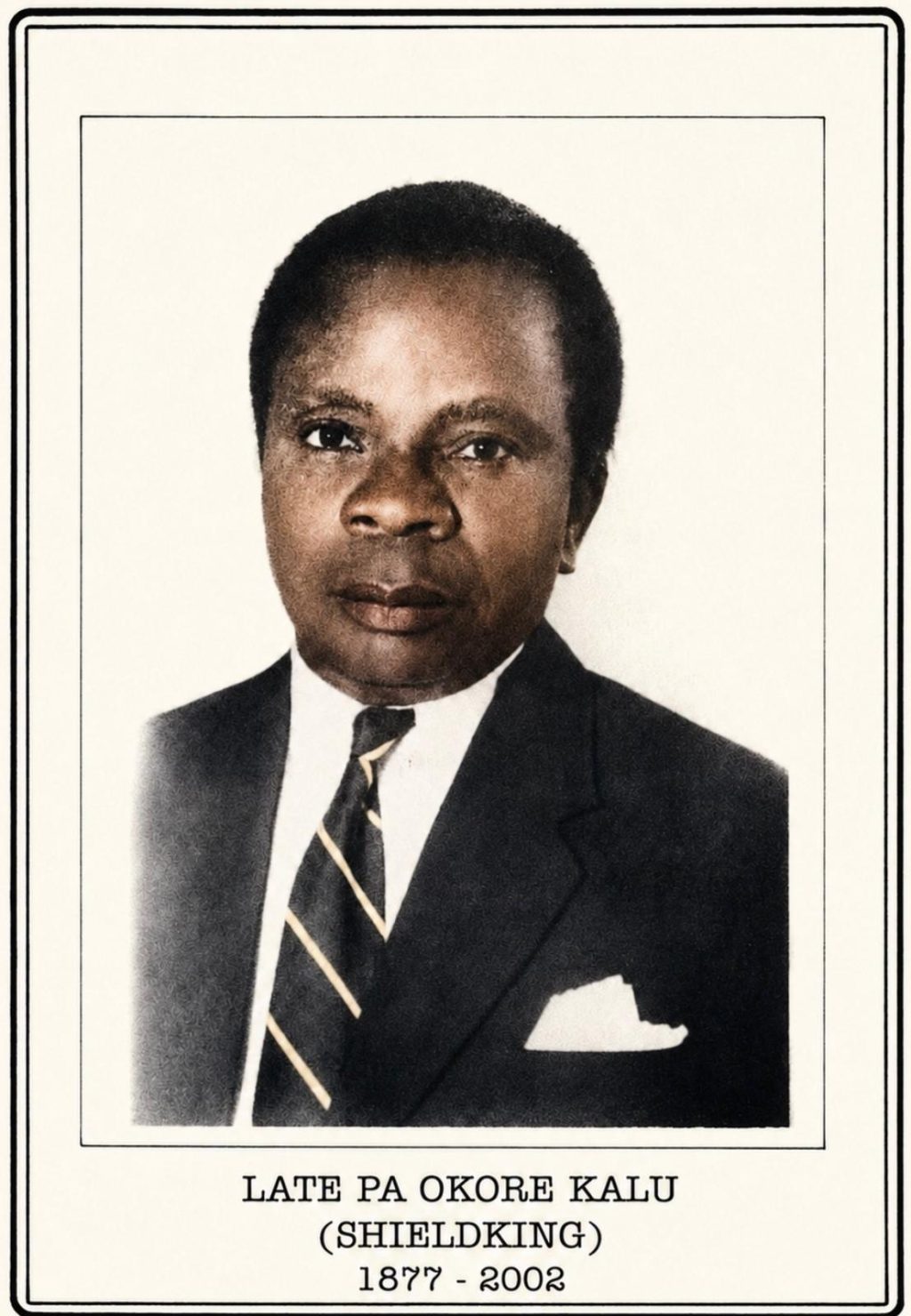
Every generation in Ututu chooses the people it celebrates. Some names become larger than life, while others quietly disappear, not because their achievements were small, but because time, changing values and fading memories pushed them aside. Ututu has such a man. His name was *Pa Okore Otaeze Kalu*, though most people knew him simply as Shieldking.
Today, many young people have never heard of him. Yet there was a time when no discussion about business, money or opportunity in Ututu was complete without mentioning his name. He was a financier, money lender, merchant, property owner, community leader and philanthropist who used his success to help others advance.
Pa Okore was born in August 1877 in Obijoma Ututu. His father died when he was nine, and his mother died two years later. Orphaned at 11, he endured severe hardship and sometimes survived on palm kernels ground with pepper.
He never attended an established school. An itinerant teacher taught him enough to begin reading and writing, and he developed that modest foundation through observation, memory and determined self-education. The experience later shaped his belief that education was the best investment a family could make.
Around 1915, Mazi Kalu Okeke of Obijoma took him to Calabar. Pa Okore worked first as a houseboy and later for colonial district officers. He began as a junior domestic worker earning 15 shillings a month, then advanced through hard work, honesty and reliability to become a steward and cook. He served an officer named Mr. Shieldking for 11 years, and the name stayed with him.
Those years taught him discipline, thrift and the value of a good name. He lived modestly, saved a substantial portion of his earnings with remarkable discipline and educated himself through experience and close observation of commerce.
His rise was not easy. Around 1933, he was defrauded of 400 pounds after entering the money-lending business. The loss wiped out his life savings. He started again as a laborer earning four pence a day while also farming and selling bamboo in Calabar.
In 1939, he returned to money lending and obtained a license as a registered lender. Through steady work, disciplined saving and reinvestment, he rebuilt his finances. By the end of the Second World War, he had become wealthy and widely known in Calabar and beyond.
Finance was only one part of his success. He imported and sold motorcycles, radios, radiograms, ceramics and other goods. He represented Hansa Ltd. of Germany, became a major contractor to the Nigerian Navy and operated one of Calabar’s leading electronics stores. He also owned residential property in Calabar and Aba.
His wealth was not built on fraud. It was not built on political patronage, embezzlement, corruption or bribery. It did not come from get-rich-quick schemes, occult rituals, drug trafficking, human trafficking, kidnapping or inflated government contracts. It was built solely through enterprise, discipline, sound judgment, integrity and years of hard work.
When adjusted to today’s monetary value, Pa Okore’s wealth would make him Ututu’s first billionaire.
He was also the unofficial banker of his generation. At a time when commercial banks were beyond the reach of ordinary people, traders and small business owners turned to him for capital. His loans kept businesses alive, helped market women buy goods, enabled artisans to purchase tools and allowed families to build homes.
What distinguished him was how he decided whom to trust. He believed character came before collateral. He demanded no collateral from fellow Ututu people and asked only for their word. He also charged them less interest than borrowers from outside Ututu. His purpose was not merely to make money. It was to create opportunity and empowerment.
Long before microfinance became a recognized field, Pa Okore was practicing it. He understood that hardworking people often remained poor because they lacked access to capital. His lending gave ordinary people a chance to control their businesses, retain more of their earnings and improve their lives.
His investment in people extended to education. He sponsored Ututu sons and daughters studying in Nigeria and overseas. In 1964, he sent his second son to Britain to study aircraft engineering, a striking decision for a man who had received no formal schooling himself.
His community service was equally substantial. He led the Calabar branch of the Ututu Federated Union for 35 years, organized Ututu people living away from home and defended them against intimidation and unfounded accusations. He also served as an executive member of the Igbo State Union in Calabar. His leadership rested on courage, responsibility and service, not personal recognition.
The Nigerian Civil War destroyed much of what he had built. When federal troops entered Calabar in October 1967, he fled with his family and returned to Ututu. His commercial businesses, lending operation and property holdings were devastated.
The destruction did not end when the fighting stopped. After the war, the Federal Military Government limited Igbo bank account holders to receiving only 20 pounds, regardless of how much money they had before the conflict. Under the abandoned property policy, countless Igbo-owned homes, businesses and commercial buildings in Calabar and other parts of the former Eastern Region were confiscated and reallocated to others.
Still, Pa Okore refused to surrender to bitterness or idleness. Back in Obijoma, the former financier and importer became a farmer with the same discipline he had brought to business. He cultivated yams on such a scale that he earned the title *_Oko Ji_* and continued farming until 1985. He showed that honest work carried no shame and that a person of character could begin again after a devastating loss.
His later years reflected strong Christian commitment. He supported the Presbyterian Church in Obijoma, chaired its Men’s Christian Association and was honored as Father of the Year in 1987. Although he was repeatedly offered the royal stool of Obijoma, he declined because he believed it conflicted with his faith. He did not need a title to serve, and he would not exchange conviction for status.
Pa Okore died in 2002 as one of the oldest men in Ututu, leaving 13 surviving children, 37 grandchildren and 15 great-grandchildren. His life touched the nineteenth, twentieth and twenty-first centuries.
The greater tragedy is not only that war destroyed his business empire. It is that his memory nearly disappeared.
Today, people often celebrate wealth without asking how it was acquired. That is a dangerous mistake. Ututu is not strengthened by wealthy people alone. It is strengthened by honorable men and women whose ethics, integrity, hard work and service enrich the community.
Pa Okore belonged to that rare class of men whose wealth was respected because it was earned with clean hands. He showed that prosperity achieved through honesty carries a dignity that no amount of questionable riches can match.
His life asks difficult questions of every generation in Ututu. Can success exist without integrity? Can a community flourish when trust disappears? Can wealth truly benefit Ututu if it serves only the individual? What kind of legacy do we leave when we value riches more than character?
Pa Okore answered those questions with his life. He proved that success without integrity is empty, that trust is the foundation of every thriving community and that wealth achieves its highest purpose when it creates opportunities for others. His business strengthened families. His generosity expanded education. His confidence in people gave men and women the chance to succeed. His legacy reminds us that character outlives riches.
His life makes a direct demand on Ututu today. Entrepreneurs should emulate his disciplined and honest enterprise. Professionals should use their success to open doors for others. Borrowers should honor their word. Parents should invest in education. Wealthy people should measure success by the opportunities they create, not only by what they own.
His example is especially important for our leaders. He showed that leadership is not a title, a ceremony or a chance to control public resources. It is the work of protecting people, solving problems, earning trust and leaving the community stronger.
His story deserves remembrance, but remembrance alone is not enough. The best tribute Ututu can offer is to restore the values by which he lived: honesty, personal integrity, hard work, faithfulness to one’s word, investment in education, community service and responsible leadership.
Young people in Ututu should know that before today’s banks and before entrepreneurship became fashionable, a son of Obijoma already understood the power of capital and investment, the value of trust and the responsibility that comes with wealth.
As Ututu reflects on the people who shaped its history, Pa Okore deserves to stand once again where he belongs, among our community’s greatest builders.
His name should not remain buried in fading memories. It should be spoken with pride. His life should be taught to our children. His character should challenge our leaders. His example should inspire our entrepreneurs. He did not merely accumulate money. He multiplied opportunity. He was a force multiplier.
His legacy should remind us that true greatness is measured not only by what we possess, but by what we make possible for others.
Pa Okore Kalu, Shieldking, was overlooked. He is overlooked no more*.