
By Kalu Okoronkwo
There comes a time in the life of an individual when ambition in whatever sphere of life: political, economic, career, sports, etc, must bow to wisdom; when circumstance and environment demand that you call time on certain ambitions no matter how noble. That is why footballers and other sports men despite the love they still have for the sports, retire at a certain stage and age and pass the baton to the younger ones.
This analogy is even more germane in political leadership when real statesmen having attained or attempted to reach certain political milestones without success, leave the stage for younger political elements to come up and contribute to nation building through appointive or elective positions. Nations are shaped not only by those who seek power, but by those who have the courage to relinquish it for the greater good. That moment, urgent, defining, and inescapable now confronts Alhaji Atiku Abubakar, Waziri Adamawa and former Vice President of the Federal Republic of Nigeria.
Atiku’s imprint on Nigeria’s democratic evolution is undeniable. As Vice President from 1999 to 2007 under president Olusegun Obasanjo, he occupied one of the most consequential offices in the land at a defining moment in the country’s return to civilian rule. Those were foundational years demanding both administrative capacity and political dexterity.
By many accounts, Atiku brought energy to economic reforms, championed privatization policies, and played key roles in shaping Nigeria’s early democratic institutions. That period gave him not just visibility, but legitimacy and a platform many would consider sufficient to secure a place in history.
For decades, Atiku has embodied political endurance. From his tenure as Vice President to his repeated bids for the presidency, his ambition has been consistent and admirable even in its tenacity.
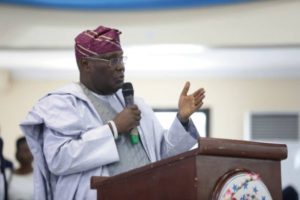
However, there is a thin line between persistence and obsession, and in politics, crossing it can quietly turn strength into liability. As Nigeria inches toward the high-stakes crossroads of 2027, Atiku’s long, unrelenting presidential quest risks becoming less a symbol of resilience and more a paradox and one that could deal a mortal blow to the opposition political parties and inadvertently handover the 2027 presidential election to Bola Ahmed Tinubu of the ruling All Progressives Congress (APC) even before the polls.
By the time of the 2027 general elections, Atiku will be nearly 80. In a nation of over 200 million people; teeming with young, educated, and capable men and women, the question increasingly being asked is not whether Atiku can run, but whether he should. Even though the Electoral Act does not state the upper age limit for political office aspirants to contest, an 80-year-old man is, biologically and in the reckoning of well-meaning Nigerians, too old to run for political office let alone the highest office in the land. Nigerians have been encumbered by the last two occupiers of the office of the president who spent most times in best hospitals in Europe instead of facing the arduous task of governance. Since we are not running a geriatric system of government, another old and frail president at a time energy of youth is required to tackle the blossoming insecurity and other challenges in the country will be a monumental disaster.
A statesmanship is defined not only by the offices one seeks, but by the moments one chooses to step aside, to mentor, and to guide. Leadership, at its highest level, is generational, it creates space as much as it occupies it.
For many Nigerians, the concern is no longer about Atiku’s credentials or experience; it is about timing, judgment, and legacy. After multiple attempts spanning more than three decades, his continued insistence on the presidency risks appearing less like perseverance and more like a greed that must be fulfilled at all costs. This perception, fair or not, is shaping public sentiment, particularly among younger Nigerians who are increasingly demanding a recalibration of leadership.
Ambition in politics, is often the engine of relevance. It drives persistence, fuels resilience, and, at its best, inspires public service. But when it hardens into entitlement; when it ceases to listen, adapt, or yield, it becomes something else entirely: hubris. And hubris, history reminds us, is rarely a private failing; it is a public burden.
From the aborted transition of 1993 to multiple presidential contests in the Fourth Republic, Atiku’s pursuit of the presidency has been one of the most enduring in Nigeria’s political trajectory. Each attempt has carried the weight of expectation, the hope of reinvention, and the promise of “this time.” Yet, despite his reach, resources, and recognition, the ultimate prize has remained elusive.
There comes a point in every political journey when persistence must give way to perspective. For Atiku, that moment appears not only imminent but necessary. Nigeria today is not the Nigeria of 1999. It is younger, more restless, and more demanding of change. A new generation of voters: digitally aware, economically pressured, and politically conscious, is increasingly unwilling to recycle old hierarchies without question. Their aspirations are shaped less by nostalgia and more by urgency.
Within that urgency, new figures have emerged as vessels of hope. Among them are Mr. Peter Obi and Senator Rabiu Musa Kwankwaso among other leaders who, in different ways, have captured the imagination of younger Nigerians. They represent not perfection, but possibility; not consensus, but momentum. It is here that Atiku’s burden becomes most apparent.
Having once chosen Peter Obi as his running mate, Atiku demonstrated, however briefly, an awareness of the importance of generational bridge-building. That decision was more than strategic; it was symbolic. It suggested a willingness to integrate new energy into established structures. But symbols, if not sustained, eventually collapse under the weight of contradiction. Today, the call is no longer for symbolic inclusion; it is for substantive transition.
Within the fragile architecture of opposition politics in Nigeria, particularly around the African Democratic Congress (ADC), unity is not optional; it is existential. The stakes of the 2027 election, especially in the context of governance under President Tinubu, have heightened the need for a coherent, disciplined, and forward-looking alliance. Any internal fracture risks not only political defeat but also the erosion of public trust in the very idea of change.
It is against this backdrop that Atiku’s recent interview on Arise Television, conducted by Charles Aniagolu, has stirred concern. His assertion that figures such as Senator Rabiu Musa Kwankwaso, Mallam Nasir El-Rufai, and Alhaji Aminu Tambuwal “are not as popular” in the North as he is, has been widely interpreted as more than a political misstep. These are individuals who have governed states, held national offices, and built significant constituencies. To diminish them publicly signals deeper concerns about cohesion, mutual respect, and leadership temperament.
What does it say to allies when a coalition leader appears to undercut them in pursuit of personal ambition? How does such a posture strengthen a movement that depends, above all else, on unity? More critically, what does it reveal about the balance between collective purpose and individual aspiration?
Politics is as much about perception as it is about power. In that moment, the optics was difficult to ignore: a veteran statesman seemingly placing personal ambition above coalition harmony. For many observers, it suggested not just confidence, but a troubling disregard for the sensitivities required to sustain a broad-based coalition. It raised a deeper concern that Atiku’s loyalty may be anchored less in shared vision and more in the singular pursuit of the presidency.
That is the peril of unchecked ambition. It narrows vision, recasts compromise as weakness, and turns succession into surrender. It risks transforming allies into obstacles and a collective mission into a personal crusade.
For Atiku, however, the path forward need not be defined by withdrawal, but by transformation. There is a role, perhaps, even a greater one awaiting him: that of a statesman, mentor, and political father figure who shapes outcomes without dominating them. It is a role that demands sacrifice, but offers legacy; one that requires restraint, but commands enduring respect.
In the United States, Joe Biden spent decades in public service, including as Vice President to Barack Obama, demonstrating the power of generational partnership, experience anchoring vision, youth energizing structure. In South Africa, Nelson Mandela served a single term and stepped aside, allowing a democratic culture to flourish beyond his towering presence. His restraint did not diminish his legacy; it immortalized it.
Should Atiku insist on another presidential run without fostering a genuinely inclusive opposition front, he risks fragmenting the very forces capable of challenging the incumbent. Nigeria’s electoral history shows that divided opposition often paves the way for incumbents, not necessarily because they are overwhelmingly popular, but because their challengers fail to unite.
A crowded opposition field could split votes along familiar lines; regional loyalties, party affiliations, and personality-driven followings. In such a scenario, the path to re-election becomes less about expanding support and more about benefiting from division.
Nigeria stands at a critical intersection. Its challenges: economic strain, institutional fragility, and generational discontent demand not only experience, but humility; not only ambition, but restraint. The moment calls for leaders who can unify, inspire trust, and understand when to lead from the front and when to lead from behind.
The Waziri’s legacy is already significant. His contributions to Nigeria’s political evolution are undeniable. But legacies are not defined solely by what one achieves; they are also shaped by what one chooses to relinquish.
He has spent decades seeking to lead Nigeria. Perhaps the time has come to help shape its leadership instead; to deploy his experience, network, and influence in support of a new generation of leaders like Peter Obi and Rabiu Musa Kwankwaso, who embody the aspirations of a changing nation.
This is not a call to irrelevance; it is a call to a higher relevance.
Because, in the end, the true measure of leadership is not how long one holds power, but how wisely one prepares others to wield it. And in that transition; from contender to custodian, Atiku may yet find the legacy that has eluded him at the ballot box.
Unchecked ambition builds careers. Restrained ambition builds nations.
Kalu Okoronkwo is a communications strategist, a leadership and good governance advocate dedicated to impactful societal development and can be reached via kalu.okoronkwo@gmail.com