
By Kalu Okoronkwo
There are times in the life of a democracy when politics is not merely a contest for power but also a test of political maturity. Nigeria may well be approaching such a defining moment if the discussions within the camps of Nigeria’s opposition parties are anything to go by.
In April 2026, opposition leaders gathered in Ibadan, the Oyo State capital, and declared their intention to work together to field a single presidential candidate against the ruling All Progressives Congress (APC) and its candidate, President Bola Ahmed Tinubu, in the 2027 general election.
The summit brought together prominent political figures, including former Vice-President and presidential candidate of the African Democratic Congress (ADC), Alhaji Atiku Abubakar; former Governor of Anambra State and presidential candidate of the Nigeria Democratic Congress (NDC), Peter Obi; former Governor of Kano State and vice-presidential candidate of the NDC, Senator Rabiu Musa Kwankwaso; former Governor of Cross River State, Donald Duke; and the incumbent Governor of Oyo State, Seyi Makinde, among other political leaders drawn from Nigeria’s opposition parties.
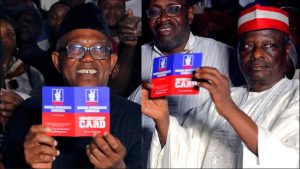
But weeks later, the coalition’s unity came under considerable strain as different parties and political blocs began pursuing separate strategies and candidates. The development exposed the central contradiction confronting Nigeria’s opposition: everyone appears to agree that unity is necessary, but not everyone appears willing to pay the political price that genuine unity requires.
With the opposition parties proposing another ‘single candidate summit’, initially scheduled for August 18 but subsequently moved to August 31, 2026, the question that should occupy the minds of their respective leaders is: can the leading opposition figures subordinate personal and partisan ambition to a larger national interest and agree on an arrangement capable of producing competent, credible and unifying leadership? Or, given Nigeria’s political complexities, should the more consequential question be: who can bring together the broadest coalition of Nigerians around a credible programme of national rebirth?
Within this debate, Peter Obi occupies an unusual position. He is neither a product of the traditional presidential establishment nor a political newcomer. In the run in to the 2023 general elections, Obi transformed from a relatively conventional opposition politician into the pivot of a remarkable political movement. The “Obidient Movement” remains the most organic support for any presidential candidate since Nigeria’s independence from the British colonial rule in 1960.
The Independent National Electoral Commission’s declared results for the 2023 presidential election gave Obi 6,101,533 votes, representing 25.40 per cent of the valid votes cast, placing him third behind Bola Ahmed Tinubu and Atiku Abubakar. But despite the declaration of the Supreme Court that Tinubu won the election, the argument on who actually won the 2023 presidential election has refused to die down in the court of public opinion. Many point to (with compelling arguments too), to Obi’s overwhelming victory in that election.
Obi’s 2023 campaign demonstrated that a candidate running on a relatively weak political platform could penetrate constituencies traditionally dominated by the established parties, mobilise large numbers of young and urban voters, and emerge as a serious national political force. Given the huge traction that Obi’s candidacy garnered in 2023, will the candidates of other opposition parties queue behind him in 2027 as a path to unseating APC and Tinubu?
When measured against objective criteria: competence, integrity, national acceptability, electoral viability and capacity to unite Nigeria, Obi offers a stronger basis for consensus among the contending candidates.
Long before “Obidient” became a political identity, Peter Obi had already established a public profile as a businessman and politician. He served as Governor of Anambra State from 2006 to 2010 and again from 2011 to 2014, following a period in which his first tenure was interrupted by impeachment and subsequently restored through judicial intervention.
His supporters have consistently identified his approach to public finance as one of the defining features of his tenure. Obi has repeatedly maintained that he left substantial financial resources in Anambra’s treasury at the end of his administration. Unlike some other Governors who allocated choice landed properties and ‘perks’ of office to themselves while in government and ‘decreed’ obscene pension benefits to themselves while out of office, Obi left Anambra State government with neither land allocated to him nor any pension benefits. He is perhaps the only former state Governor, ex- minister, or former or serving members of the National Assembly without a personal house in Abuja.
But whether such credential should determine the choice a consensus presidential candidate among the ranks of the opposition parties is another matter. The broader reputation associated with Obi’s politics has endured. He has become identified with an emphasis on fiscal discipline, people-centred policies, reduction of poverty, inclusive government, reform and investment in education, healthcare and infrastructural developments. His supporters regard these policies as evidence that government can be run more like a disciplined institution than a financial bazaar.
That reputation matters because Nigeria’s governance problem is not simply a shortage of money. It is also the difficulty of converting public resources into measurable public value. A consensus candidate must therefore be judged not merely by what he promises to do with Nigeria’s enormous resources, but by what his previous public record suggests about how he might manage them.
Perhaps the most politically potent aspect of Obi’s candidacy is the perception among his supporters that he represents a break from the culture of impunity often associated with Nigerian politics. But the more significant argument for Obi may not be what he did in Anambra. It may be what happened during the 2023 general elections.
In 2023, Obi took the Labour Party, a platform without the institutional machinery of the APC or PDP, and transformed it into a formidable presidential vehicle. He secured more than six million votes nationally, won the South-East overwhelmingly, secured substantial support in the South-South and North-Central regions, and made significant inroads into parts of the South-West.
The declared results showed, for instance, that he won approximately 1.21 million votes in the South-South and more than 1.4 million in the North-Central region, while receiving almost 846,000 votes in the South-West. These figures matter because they demonstrate that his appeal was not confined entirely to his regional base.
The Financial Times observed that Obi’s 2023 campaign energised younger voters and urban professionals, while the “Obidient Movement” demonstrated a new form of political mobilisation outside the traditional structures of Nigeria’s established parties. WIRED similarly documented how young Nigerians used social media, volunteer networks and grassroots mobilisation to build support for Obi, including crowdfunding and offline organisations that compensated for the Labour Party’s institutional limitations.
A candidate capable of creating a movement where there was previously little conventional party infrastructure possesses an asset that cannot easily be manufactured through political negotiation.
Nigeria’s presidency cannot be won through South-East support alone. The 2023 announced results by INEC, demonstrated both Obi’s regional strength and his capacity to reach beyond it. He won all five South-East states, Lagos State , the Federal Capital Territory, while also winning multiple states in the South-South and securing significant support in the North-Central region.
Obi’s support was considerably weaker in the North-West and North-East than that of Atiku Abubakar or Bola Tinubu. Kwankwaso, meanwhile, demonstrated formidable strength in Kano and parts of the North-West.
If Obi is to emerge as a consensus candidate, the central strategic question is whether another major political figure, particularly one with stronger northern networks, such as Kwankwaso can help transform Obi’s existing national reach into a genuinely nationwide coalition. That is where coalition politics becomes more significant than individual candidacy.
The argument for Atiku Abubakar is straightforward: experience, national organisation, northern reach and extensive familiarity with presidential politics. He has contested the presidency several times and possesses a political network that stretches across much of the country. For some Nigerians, that experience is an asset. For others, it represents the persistence of an older political order.
The question, therefore, is whether Atiku’s organisational strength and political experience can compensate for whatever limitations voters perceive in his candidacy. That question deserves to be answered objectively, just as Obi’s candidacy should be.
The purpose of a consensus process should not be to predetermine the winner but to identify the candidate who offers the opposition the strongest prospect of winning and governing effectively.
Compared with Atiku’s running mate, former Governor of Rivers State Rotimi Amaechi, the political proposition represented by Obi’s running mate, Senator Rabiu Musa Kwankwaso, is considerably different. Kwankwaso secured 1,496,687 votes nationally in 2023, substantially fewer than Tinubu, Atiku and Obi. Yet his political strength was heavily concentrated in Kano and parts of the North-West, making him a potentially significant asset in any opposition presidential configuration.
Kwankwaso brings extensive political experience, grassroots structures and a substantial northern constituency to the table. That reality gives the emerging Peter Obi–Rabiu Kwankwaso ticket considerable significance.
Obi and Kwankwaso contested separately in 2023, finishing third and fourth respectively. In 2027, however, they are running together under the Nigeria Democratic Congress. The significance of this arrangement goes beyond the two men themselves.
Obi brings a reform-oriented national profile, substantial support among younger voters and professionals, and the momentum of the Obidient movement. Kwankwaso brings extensive northern political experience, a formidable grassroots identity and the organisational influence of the Kwankwasiyya movement. Together, they potentially offer the opposition a combination of political assets that neither man possesses alone.
The Obi–Kwankwaso ticket offers the opposition at least five potentially important assets: one, geographical complementarity. The ticket combines two political figures whose strongest constituencies are concentrated in different regions. Obi’s strongest base is in the South-East and parts of the South-South, while Kwankwaso has considerable influence in the North-West, particularly Kano. Two, movement and machinery. Obi brings the energy, enthusiasm and mobilisation capacity of the Obidient movement, while Kwankwaso brings an established grassroots political network and the organisational experience of the Kwankwasiyya movement. Three, generational breadth. The ticket has the potential to connect younger, reform-oriented voters with an experienced political network rooted in grassroots mobilisation. Four, a broader national narrative. Rather than presenting itself as the vehicle of a single region, the ticket can frame itself as a North-South political partnership built around a broader national project. And five, alternative to conventional opposition politics.
The Obi-Kwakwanso combo offers an opportunity to construct a political narrative that goes beyond simply replacing one established political elite with another. It is a choice between political entitlement and political responsibility; between fragmented ambition and strategic cooperation; between selecting the candidate who best satisfies individual parties and selecting the candidate who best serves the national interest.
Nigeria does not need opposition parties to surrender their identities. It needs them to understand that political identities are instruments of democratic representation, not substitutes for national purpose.
If Peter Obi ultimately emerges from a transparent and credible process as the candidate who best satisfies the tests of competence, integrity, national acceptability, electability and capacity to unite Nigeria, the opposition leaders should rally around him to usher a new era of purposeful, responsible and accountable governance with tangible and measurable utilitarian values.
The 2027 election should not be reduced to a contest over who has the strongest claim to the presidential crown. The more consequential question is whether Nigeria’s opposition can rise above personal ambition and partisan calculations to identify the candidate most capable of earning a broad national mandate and governing effectively thereafter.
Obi’s political trajectory gives him a strong case for serious consideration. His record in Anambra, his reputation for fiscal discipline, the extraordinary mobilisation around his 2023 candidacy and his ability to penetrate constituencies beyond his traditional regional base make him an important figure in the opposition’s search for a credible alternative.
The opposition leaders must decide whether they are prepared to put the national interest ahead of individual ambitions. Given the outcome of the governorship election in Osun State despite strong intimidations and other shenanigans by the ruling APC, there is hope that if the opposition parties subsume personal egos and interests and embrace a more patriotic national interest, there is the possibility of unseating the APC and President Tinubu in the 2027 election.
Time is running out. Opposition parties cannot afford to continue to oppose themselves. They should muster their strengths to face a common enemy- the APC.
Kalu Okoronkwo is a communications strategist, a leadership and good governance advocate dedicated to impactful societal development and can be reached via kalu.okoronkwo@gmail.com