
By Kalu Okoronkwo
In Nigeria, the fiercest political battles are not always fought on campaign podiums. Sometimes, the most consequential struggles for power are waged quietly from the pulpit, wrapped in sermons, prophetic declarations and carefully coded spiritual language that slips into the subconscious of millions of voters. During election seasons, religion often transcends faith and devotion to become a formidable instrument of influence, emotional persuasion and psychological conditioning in the ruthless contest for political power. Beneath the echoes of “Amen” and prophetic utterances, political loyalties are shaped, public emotions manipulated, hope either ignited or destroyed, and entire voting populations subtly programmed long before the first ballot is cast.
Recent events strongly attest to this troubling development in Nigeria’s political journey. As the nation gradually inches toward 2027, Nigeria is once again entering that familiar and dangerous season in which religion becomes deeply entangled with political calculations. Sermons are changing, prophecies are multiplying, spiritual programmes are becoming politically suggestive, and influential clerics are increasingly stepping into the center of national political discourse, not merely as moral voices, but as actors capable of shaping electoral outcomes.
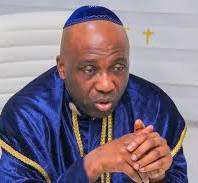
In late 2025, Nigerians woke up to a highly controversial dispute involving Primate Elijah Ayodele of the INRI Evangelical Spiritual Church, located in the Oke-Afa area of Lagos State, and the then Minister of Power, Bayo Adelabu. The cleric was accused of attempting to extort ₦150 million from the minister for alleged spiritual intercession concerning the 2027 Oyo State governorship election. Adelabu reportedly petitioned the Department of State Services (DSS), alleging that Ayodele demanded ₦150 million, 24 APC flags and 1,000 trumpets to secure electoral victory for him.
Ironically, religion in Nigeria is not merely about belief; it is power, identity and emotional influence. This is why politicians fear the pulpit almost as much as they fear the ballot box. The Nigerian politician understands a simple reality: millions of citizens may doubt politicians, but they rarely doubt their pastors, prophets or imams. A politician must campaign for trust; a cleric already possesses it. In a deeply religious society burdened by poverty, insecurity and hopelessness, spiritual authority often carries more emotional weight than public policy itself.
This intersection between faith and politics raises troubling questions: what exactly should be the role of spiritual fathers in political matters? Should clerics remain silent while society collapses under bad leadership? Or have some religious leaders dangerously transformed the altar into an extension of political machinery? The debate is neither simple nor new.
Both the Bible and the Quran acknowledge the moral responsibility of spiritual leaders in matters affecting society and governance. Throughout scripture, prophets confronted kings, challenged injustice and warned nations against corruption and oppression.
In the Bible, Prophet Nathan openly confronted King David over abuse of power and moral failure. Elijah stood fearlessly before Ahab and Jezebel, condemning wicked leadership and national corruption. Moses challenged Pharaoh’s oppressive system and demanded liberation for suffering people. John the Baptist publicly criticized King Herod’s immoral conduct despite the personal danger involved.
Even Jesus Christ, though cautious about political manipulation, never ignored societal injustice. He confronted exploitative religious systems, challenged hypocrisy among leaders and defended the oppressed. Christ also established an important moral balance when He declared, “Render unto Caesar what belongs to Caesar, and unto God what belongs to God.” It was a profound warning against the dangerous fusion of spiritual authority and political domination.
The Quran equally presents examples of spiritual and moral leadership confronting political injustice. Prophet Musa (Moses) challenged Pharaoh’s tyranny and oppression, while Prophet Ibrahim stood against corrupt authority and false systems of power. Islamic teachings consistently emphasize justice, accountability and the moral duty to oppose oppression regardless of political status.
In both Christianity and Islam, therefore, spiritual leadership carries a responsibility to defend truth, justice and human dignity. However, there is a critical difference between moral guidance and political manipulation. That distinction is where Nigeria’s crisis increasingly lies.
Over the years, Nigeria has witnessed the rise of highly influential clerics whose political pronouncements significantly shaped public opinion and, in some cases, electoral outcomes. Few figures symbolize this reality more dramatically than Father Ejike Mbaka. At the peak of his political influence, Mbaka’s prophecies became national political events. In 2015, his fierce criticism of former President Goodluck Jonathan and endorsement of Muhammadu Buhari emotionally mobilized many Christian voters who interpreted his position as divinely inspired.
Years later, as economic hardship and insecurity worsened under Buhari’s administration, Mbaka himself became one of the government’s vocal critics. The same spiritual authority that once legitimized political hope eventually amplified public disappointment.
During the 2020 Imo State governorship crisis, Mbaka predicted that Senator Hope Uzodinma would emerge governor, a prediction that later materialized through a Supreme Court judgment. In 2023, allegations also emerged that the failure of former Anambra State governor, Peter Obi, to financially support Mbaka’s Adoration Ministry allegedly influenced the cleric’s prediction that Obi would lose the presidential election. Mbaka, who was suspended by the Catholic Church in Nigeria in 2022 and sent to a monastery over concerns surrounding perceived political manipulation from the altar, has consistently denied that his prophecies are politically motivated, insisting instead that they are divine revelations.
These episodes exposed the dangerous consequences of clerical political endorsements. When prophecies become politically invested, public trust in both democracy and religion can suffer whenever governance fails.
Tunde Bakare perhaps remains one of Nigeria’s most openly political clerics. Unlike pastors who operate through symbolic prophecy, Bakare stepped directly into partisan politics as Buhari’s running mate in 2011. Through sermons and national broadcasts, he consistently positioned himself as both spiritual leader and political commentator.
Bakare represents the evolution of the Nigerian cleric from moral observer to ideological participant. Supporters view him as courageous and intellectually honest, while critics argue that his political involvement reflects how easily the pulpit can drift into partisan territory.
The pulpit is no longer influencing politics only from a moral distance; it is gradually becoming an active arena of political calculation. The 2023 elections perhaps revealed this reality more sharply than any period in Nigeria’s democratic history.
In the build up to the 2023 elections, and in an attempt to market the Muslim-Muslim ticket, the controversial “arranged bishops” episode emerged. Men dressed in clerical attire appeared at the unveiling of Kashim Shettima as the vice-presidential candidate to Bola Tinubu in Abuja. The supposed bishops were widely perceived as actors or impostors recruited to create the impression of Christian support for the Muslim-Muslim ticket.
Religious identity consequently became one of the most emotionally charged dimensions of political debate. The controversy surrounding the ruling party’s Muslim-Muslim presidential ticket exposed the fragile intersection between faith, representation and political power. Across the country, clerics openly expressed concerns, endorsements and warnings that shaped national conversations far beyond the walls of worship centers.
Pastor Enoch Adeboye, General Overseer of the Redeemed Christian Church of God, occupies another unique position within Nigeria’s political psychology. Though often more restrained in public political commentary, his enormous spiritual influence means even the slightest statement carries national implications. In a country where millions regard him as a spiritual father, any suggestion about leadership, divine choice or national direction instantly becomes politically consequential.
When clerics of such stature speak ambiguously about “God’s chosen leader” during election seasons, many followers subconsciously begin to interpret democratic participation through divine lenses. The danger is that such messaging can weaken civic responsibility by making electoral outcomes appear spiritually predetermined rather than democratically earned.
Similarly, Matthew Ashimolowo has, in recent times, made politically loaded observations capable of shaping public psychology. Statements acknowledging the competence of a candidate such as Peter Obi, while simultaneously suggesting inevitable defeat, may appear harmless on the surface. Politically, however, such rhetoric can psychologically weaken voter morale. This is how weaponized religion often functions, not always through direct endorsement, but through emotional conditioning.
The danger is not necessarily that religious leaders speak about national affairs. Silence in moments of injustice can itself become moral failure. The deeper concern arises when spiritual authority begins to manipulate political emotions in ways that discourage critical thinking, civic participation and democratic responsibility. At no point did Jesus Christ compel political loyalty through fear or emotional coercion. Rather, He emphasized truth, compassion, justice and free moral choice.
Even in biblical history, God consistently allowed human beings the dignity and consequences of choice. From Israel’s demand for kings despite prophetic warnings, to Judas’ betrayal despite his proximity to Christ, the scripture repeatedly demonstrates the reality of free will. Human beings make decisions, and societies live with the consequences.
Nigeria today is also the product of choices. Bad leadership is the result of choices. Corruption is the result of choices. Silence is the result of choices. And meaningful change, if it ever comes, will also emerge from choices. God will not descend from heaven to cast ballots; Nigerians will.
That is why the growing psychological messaging from parts of the religious space deserves careful scrutiny. When citizens are repeatedly conditioned to believe that change is impossible, resistance weakens long before democratic participation even begins.
When economic performance can no longer convincingly defend itself; when fuel prices soar, food inflation deepens, businesses collapse and public frustration intensifies, political actors often turn toward emotional management. If citizens cannot be persuaded materially, they may instead be subdued psychologically. Religion becomes useful instrument because it speaks directly to fear, hope and emotional dependence.
This does not mean every pastor or imam speaking on politics is compromised. Many sincere clerics genuinely desire national healing and justice. Some have courageously confronted oppression and defended democratic values at great personal risk. Bishop Matthew Hassan Kukah stands out here. For decades, Kukah has spoken out against bad leadership, corruption and injustice at different fora. He has been a champion of good governance in Nigeria even leading several civil society groups demanding for people-centred leadership.
As 2027 approaches, Nigerians must therefore learn to separate genuine spiritual guidance from politically weaponized religious influences. Faith should inspire conscience, wisdom and justice, not emotional surrender, political fatalism or democratic apathy.
The future of Nigeria cannot be outsourced entirely to prophets, marabouts or spiritual authorities. Democracy still demands participation, vigilance and independent judgment. Ultimately, the ballot box remains not only a political responsibility, but also a moral expression of the kind of nation citizens choose to build.
And no prophecy can permanently replace the power of informed individual choice.
Kalu Okoronkwo is a communications strategist, a leadership and good governance advocate dedicated to impactful societal development and can be reached via kalu.okoronkwo@gmail.com.